Most teams don't fail at strategy. They fail at translation.
The strategy exists. The team is capable. The direction is clear. And yet somewhere between the room where the decision was made and the week execution was supposed to begin, the thread goes quiet - and no one can say exactly when it happened.
A decision gets made. No one writes it down. One team interprets it one way, another interprets it differently, a third assumes the priority has already shifted. By the time work begins, three versions of the same strategy are in motion. None of them quite right.
The thinking was there. The intent was real. Then time passed, and the sentences started.
Work continues. But not in a line. And we reach for the familiar diagnosis: better alignment. Clearer communication. A stronger strategy.
Those symptoms point to something quieter and more common: the space between thinking and doing is wildly underscaffolded.
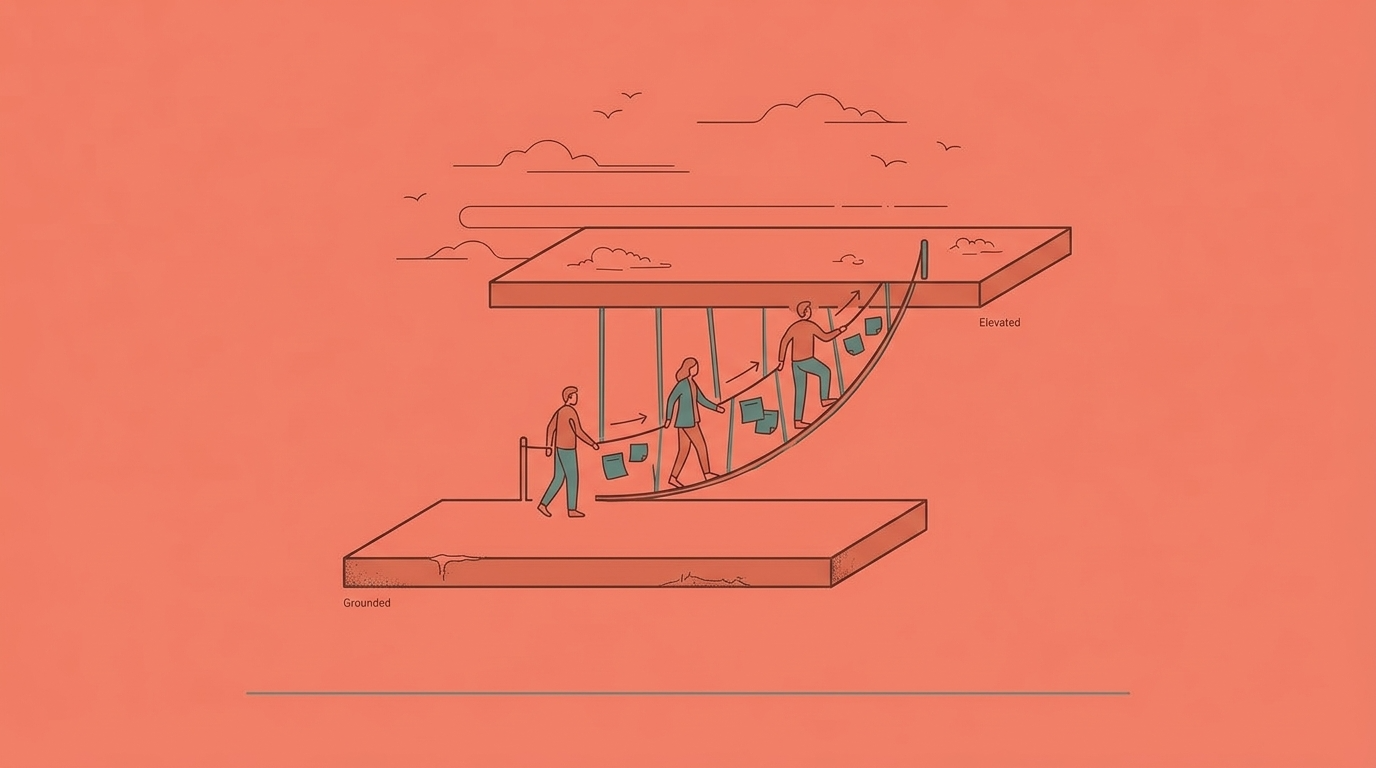
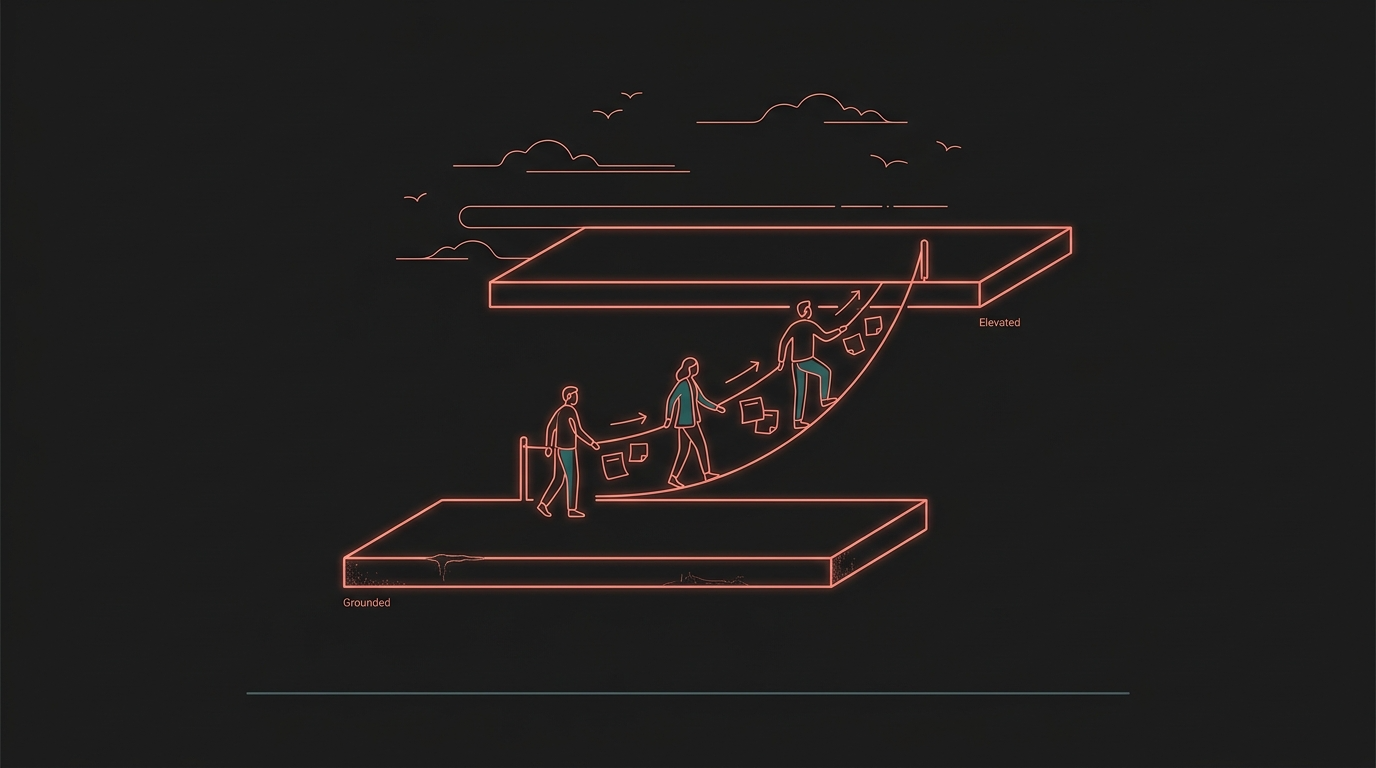
Strategy Lives Up High. Execution Lives Down Low.
Strategy is altitude: direction, intent, possibility. Execution is ground truth: precision, prioritization, trade-offs, ownership, timing.
Failure doesn't usually happen on either end. It happens in the conversion layer between them - the space where intent becomes interpretation, and interpretation becomes action.
A leadership team aligns on a product direction during a two-day offsite. The PM leaves with one set of priorities. The engineers leave with another. Neither is wrong. They simply filled in the gaps with different assumptions, and no one noticed until the rework started six weeks later.
The reason this pattern repeats regardless of industry, team size, or leadership quality isn't a people problem. It's a structural one. Every time strategy passes through hands, something is lost or reinterpreted. Not out of carelessness. Out of absence - the absence of a system designed to carry meaning forward.




The Translation Ladder
If the gap isn't strategy or execution, what actually sits between them? The answer is translation - the deliberate act of converting direction into action without losing the thread.
Translation is not making it simpler. It's making it actionable. It requires moving through a specific sequence: direction to decisions, decisions to priorities, priorities to trade-offs, trade-offs to ownership, ownership to measurable progress.
What are we deciding explicitly because of this strategy?
What moves to the top, and what drops down? Without explicit ranking, everything is the priority - which means nothing is.
What are we not doing? What are we de-scoping? What are we delaying? Trade-offs are where strategy becomes real. Skipping this step is how you end up doing everything poorly.
Who owns what? What's the very next step? What does "done" mean?
How will we know if it's working, and how often will we review it?
This ladder looks obvious. It isn't. Most of the pain inside execution is the accumulated cost of skipping one rung - and not knowing which one.
Most organizations skip this sequence entirely. They compress it. They assume it's happening through meetings and status updates. It isn't. It's happening inside people's heads - unevenly, inconsistently, and invisibly - until something breaks and no one can trace why.
A company decides to enter a new market. Leadership aligns on the direction in a single session. The deck gets circulated. What never gets decided: which existing customers get deprioritized, which product investments get paused, who owns the go-to-market sequencing, and what success looks like at 90 days. Six months later, three teams are executing three different interpretations of the same strategic intent. The market entry is late. The blame is distributed. The gap was never strategy. It was always translation.
The Hidden Anti-Pattern: Humans Become the API
Here's what's happening in most organizations. Slides live in shared folders no one can find. Roadmaps live in tools. Tickets live in systems. But meaning lives in people.
So humans become the connective tissue. The person who remembers what was really decided. The one who catches what got dropped between meetings. The one who holds the thread so the whole thing doesn't unravel.
We've made humans the API between
strategy and execution.
It works until it doesn't.
Until someone leaves. Until something changes. Until you scale. Humans are essential - but they are not a system. And when the structure depends on them to carry meaning forward, execution becomes fragile by design.


Capability isn't missing. Structure is.
Why Decks Are Where Good Strategy Goes to Nap
Strategy decks aren't useless. They're just incomplete. A deck captures direction. But direction isn't the problem.
Decks freeze thinking in time. They preserve the logic of the moment the slide was written - not the living complexity of what execution will actually demand. Everyone nods, the meeting ends, the deck gets filed. But a nod is not a decision, and a filed deck is not a system.
Decks don't encode trade-offs. They don't record what was decided against, who owns what when priorities collide, or what happens when the plan meets reality. The gap they leave behind is exactly where the translation breaks down.
The decisions log. The trade-off record. The ownership map. The review cadence. Without those, strategy becomes a moment in time: a phase, a deliverable, a "hit send."
Strategy becomes a moment in time.
Execution is a living system.
We confuse the two constantly.
The problem isn't that organizations can't think clearly. Most can. The problem is structural: there is no scaffolding between the thinking and the doing. No system designed to carry meaning forward as context shifts, people change, and priorities evolve.
So the work isn't more strategy.
It's better translation.
Teams don't have a strategy problem. They have a translation problem. And translation, it turns out, is an infrastructure problem - one that no deck, no offsite, and no alignment meeting has ever solved structurally.
New approaches are starting to emerge that treat translation as a system - not a meeting, not a document, not a person. Whether they take hold depends on whether organizations are willing to name the real gap.
The gap was never strategy.
It was always the space in between.
If you're curious, start here →
This is not a theory. This is how it runs.
Enter the system →